
Sickness of the Will
"After all, I wasn't crippled in any way . . ." (58).
Sylvia Plath's The Bell Jar (1963)
Points
for Reflection
Sylvia Plath's The Bell Jar (1963), chps. 1-10
- does Esther Greenwood's (the narrator's) preoccupation with death seem consistent with other elements of her personality?
- Esther doesn't enjoy meeting blind dates who are ugly or have a bad leg, telling herself, "After all, I wasn't crippled in any way . . ." (58). Is this true?
- does Esther's ongoing identity crisis seem "normal" and familiar, or is it extraordinary enough to signal some kind of mental imbalance?
- what features does Esther find most attractive in men, and what does she really want from them as a nineteen-year-old woman?
- in those moments where Esther gazes at her reflection in a mirror, what does she see?
- what kind of moral guidelines does Esther live by as a nineteen-year-old?
- Esther spends more energy describing her disdain of empiricism than her ardent passion for poetry and the Arts. What exactly does she so dislike about the scientific approach to life?
- at what points does Esther espouse a feminist agenda?
- why does Esther so value the quality of intuition in others like Darlene and Constantin, and what does she appear to mean by the word "intuition"?
- Buddy's father believes that "all sickness was sickness of the will," suggesting that one only gets sick if one lacks direction and determination (91). Is this true of Esther? Does she lack will power, and would it be appropriate to call her--in any way--"sick" (91)?
- why does Esther plunge down the slope when she has virtually no experience skiing (97)?
- why does she cast her new wardrobe into the night air from her tall hotel in New York city, the night before she returns home (111)?
- why might Esther leave alone (113) the blood placed on her face by Marcos (110)?
- what signs of psychosis begin to emerge in chapter ten?
- do Esther’s thoughts about creating literature soothe her wounded soul in chapter ten?
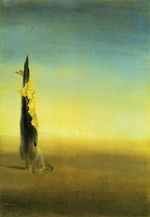
The Birth of Liquid Fears (1932), oil on canvas
Salvador Dali
Dr. Paul Marchbanks
pmarchba@calpoly.edu


