
Something More Than a Stranger
"Few ever noticed him save in a way that stung."
W. E. B. DuBois's "The Comet" (1920)
Points
for Reflection
Charlotte Perkins Gilman's Herland (1915)
Chps. 1-4
- Does Gilman describe her female characters in great physical detail? Why or why not?
- This novel appears in 1915, five years before women achieve voting rights in the U.S. Does Gilman address this issue in any way?
- How have these women managed to remain (largely) undiscovered for so long?
- Is the trio of men diverse enough to constitute a representative spread of masculine types in the period, or does Gilman leave out some important types you would have liked to see tested by this adventure?
- As concerns their attitudes towards women, Terry and Jeff lie along separate ends of a continuum. Is one extreme preferable to the other, or are both equally troubling?
- What do the various men’s conjectures about the country of women, prior to meeting them, reveal about their respective temperaments?
- Do the women wear their hair like those back home?
- How well do the men’s rather distinct classes of imagination (22) serve them?
- Does Jeff’s general enthusiasm (15) blind him or grant him special clarity?
- Why is Terry so self-assured, and does this confidence win him what he expects?
- Mary Wollstonecraft holds that females should have ample opportunities to exercise and develop their physical strength as well their minds, and should spend less time on their appearance. Does our novel’s author privilege one faculty over the other when configuring these women’s physical and mental traits?
- Terry affirms that no women could have constructed the buildings they encounter (26). What features of the architecture so amaze the three men?
- Are the men attracted to the athleticism of the women they meet?
- What appear to be the women’s primary goals in clothing design?
- Do the women care about comfortable furniture, or do they adopt a Spartan attitude towards indoor furnishings?
- How do the women’s games differ from those the men learned back home?
- Do the women practice animal husbandry with the same animals familiar to the men?
- Do the women exhibit a familiar emotional range?
- Do the women prove themselves effective teachers?
- What does Terry so wish to find in the women’s literature, something that appears utterly absent?
- Terry follows the lead of many a colonialist in offering to a native population beautiful, hand-made ornaments. What does the women’s collective reaction suggest about their priorities?
- Do this utopia rely on any innovations akin to those characterizing the industrial revolution?
- Does Nature present more often as friend or as enemy in this strange land? What might Wordsworth, Mary Shelley, and other Romantic-era writers make of this configuration of the outdoors?
- Does this utopic society maintain a police force of any kind? How do they handle unforeseen physical challenges and threats?
- What have animals and insects taught the women about the relative importance of the two sexes? What do they understand of sexual reproduction?
- How well-prepared are the men for the surprises they encounter?
- At what points do our adult males behave and think more like children?
Chps. 5-8
- The narrator confesses that this tale differs from many popular narratives in what way?
- Recall that Sir Thomas More’s Utopia exists in a singular geographic situation, on an island with sheer cliffs and a bay navigable only by those who know the aquatic terrain well. Does Herland owe much of its uniqueness to its particular location?
- Under what conditions was this utopia born 2000 years earlier?
- Which of the men doubts the women’s tale about their history, and why?
- What conclusions does Vandyck reach concerning the “femininity” he and the other men so appreciated back home?
- The women’s individual and collective intelligence repeatedly surprises the men in what particular areas of human endeavor?
- Does this culture’s selective breeding of cats strike you as forward-thinking?
- Do the men’s admissions about their treatment of domestic pets reveal anything about their treatment of other living things?
- On what types of food do the women most heavily rely?
- To what ends to the women of Herland put their creative, artistic impulses?
- What explains the relative absence of disease among the women?
- How does the novel justify the relative absence of negative emotions in this race of women?
- What names does C. P. Gilman assign her female characters, and why?
- How does motherhood in this land differ from that elsewhere on the globe?
- How do these women control birthrates?
- Are the women of Herland competitive?
- Does this culture try to erase temperamental and cognitive differences among themselves?
- Which women are deemed “unfit” to have children in this land?
- In what ways does the men’s home culture appear preferable to that of these women?
- Vandyck, our narrator explains economic struggle by referencing the Darwinian law of survival of the fittest. Does these principles prove applicable to the women’s society?
- Which academic disciplines of western civilization map onto those in Herland?
- Are the women described with enough detail to easily distinguish them from another?
- What motivation drove the women to attempt connection with their male visitors?
- How do the men’s opinions of one another’s qualities change over time?
- Why do the women ask the men to begin providing public lectures?
- Is heterosexual romance possible in this land where men have not existed for over two thousand years?
- What factors oil the cogs of Vandyck’s burgeoning romantic relationship?
- Do Jeff’s presumptions reinforce traditional assumptions about sexual differences, or follow Mary Wollstonecraft’s lead in dissolving such distinctions?
- What is the logical problem with the way many youngsters respond to Terry (74)?
Chps. 9-12
- Students bring five questions of their own, with answers and appropriate pagination.
W. E. B. Du Bois's "The Comet" (1920), PDF
- What do Jim's interactions with those at the bank reveal about our protagonist?
- Does the sudden and complete silence faced by Jim, the messenger, seem realistic given what has occurred?
- Which thought do you think our protagonist "dared not think" (3)?
- Does the woman recognize immediately that Jim is black?
- Why might Jim pause when passing dead policemen (3)?
- At what points does Du Bois use Biblical language and allusions to deepen the significance of these fictional events?
- What assumptions can we make about the second living character from the ways her interactions with the messenger morph over time?
- Why might the mouthpiece of the switchboard so unsettle the woman?
- What drives the woman to flee from and then abruptly return to the site of the long distance phone?
- Through whose eyes do we observe events more frequently while the two main characters are together?
- What unspoken thought--what "vision of a mighty beauty--turns Jim ashen and his companion crimson (7)?
- Can you decipher the surrealistic scene that takes place while they're sitting in the car (6-7)?
- Do the two characters ever exchange names?
- Why does Jim "shrink" as he gazes at what someone placed in one hand, and what does the object in his other hand tell us about his earlier discovery in Harlem?
- Does this tale recommend cataclysms as a solution for racism?
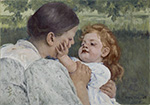
Maternal Caress (1896)
Mary Cassatt
Dr. Paul
Marchbanks
pmarchba@calpoly.edu


