
course guidelines
path one calendar
class discussion   reference pages


ornamental line

Pathetically Ineffectual


"Maybe the human race deserves to be wiped out."
Terry Gilliam's 12 Monkeys (1995)

Points for Reflection

T. Gilliam's 12 Monkeys (1995)

  1. Why is it so important that the film’s first transition involves an L-cut (in which audio from the first of two adjacent scenes carries over into the video footage of the second scene)?
  2. Why employ a slow pan to introduce Jame Cole’s post-travel adjustment instead of a tilt or zoom?
  3. Do the visual and aural cues signaling Christmas in the alternate reality first visited by James effectively invite us into this wasteland, or provide a dissonant, off-putting contrast?
  4. What does the first exterior shot of the alternate reality suggest about this strange world?
  5. What camera techniques does Gilliam employ to make the hospital and its patients appear topsy turvy?
  6. How does Gilliam capture the first-person p.o.v. of someone under the influence of heavy medication?
  7. Why employ a bird’s-eye shot of James in an isolation cell?
  8. What of Jeffrey Goines’ political views come out during the hospital tour he gives James?
  9. Why does James pause, dumbfounded, when he runs across a patient heading into an MRI machine?
  10. Each time we return to the future from which James comes, he is interrogated by a group of scientists whose specialties are not made clear to the audience—unless one activates the subtitles which identify each speaker by their specialty (geologist, microbiologist, zoologist, astrophysicist, engineer).  Why are these characters identified in the script by their specialties, not their names, and does it matter that most audiences will never know how many different types of scientists are part of the time travel project?
  11. hat about the music James hears in 1996 so compels his attention?
  12. What about the music in 1996 so compels James’s attention?
  13. Does the appearance of a street preacher prophesying the end times land with more force than it would otherwise given our knowledge of future events?
  14. How effective is Kathryn in her attempts to deconstruct James’s apparent delusions?
  15. Why did Jeffrey Goines decide not to remain with the group of young activists?
  16. What is the matter with James’s leg following his second time jump?
  17. Which of the TV shows glimpsed within the film provide an oblique commentary on the primary plot?
  18. Does the relationship between our main characters classify as a romance, remain professional, or become something else entirely?
  19. Does Mr. Goines, Jeffrey’s father, appear to regulate his research with a high moral purpose?
  20. Did James create the very event he wishes to prevent?
  21. What animal do the would-be rescuers use in their efforts to rescue the boy down the well?
  22. What events in the past might give credence to the idea that humanity’s day is done and a new beginning required?
  23. What is the source of the disembodied voice James hears throughout the film?
  24. Why, and in what way, do Dr. Kathyrn Railly and James Cole remain at cross purposes even after their respective opinions about time travel have changed?
  25. What building do we visit in both past and future?
  26. What about the particular scene from Vertigo watched by Kathryn and James in the movie theater resonates with their own experience?
  27. Why include a violent scene from Hitchcock's The Birds before allowing our heroes to exit the theater?
  28. At what point does James identify the woman in his recurring dream?
  29. What does the Army of the 12 Monkeys actually do?  What’s their final act?
  30. What is the source of James Cole’s recurring dream?


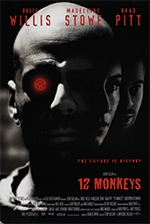
12 Monkeys one poster (1995)


Dr. Paul Marchbanks
pmarchba@calpoly.edu