
Shock and Awe
"I believe in miracles"
Ida Lupino's Outrage (1950)
Points
for Reflection
- Why does the Code attempt to encourage, and what discourage?
- Does the Code assert that motion pictures (i.e. films) function primarily as entertainment, or as teaching tools?
- Does the Code explicitly identify its intended audience as citizens of the U.S.A. only, or the world at large?
- How does the Code appear to define, implicitly, concepts like "sin" and "natural"?
- Does the Code promote any particular postures towards new and evolving filmmaking technologies?
- What attitude does the Code adopt towards the timestream? Does it, that is, privilege the past over the present, or vice versa?
- How would you, today, define "correct standards of life"? What behaviors would fall outside this domain?
- Does the Code concern itself with murder, theft, revenge, brutal killings, and child trafficking?
- What posture does the Code adopt towards the representation on screen of firearm usage, illegal drug traffic, the consumption of liquor, and sexual scenes?
- What subjects does the Code encourage filmmakers to treat "within the careful limits of good taste," and what does it proscribe altogether?
Ida Lupino's Outrage (1950)
- What tone is set by the opening montage of consecutive shots stitched together by dissolves that plays behind the opening credits?
- Why might the camera capture both Ann and the food vendor, in the opening scene, tightly squeezed between two other figures?
- How long has the street vendor been in his current job, and why does this matter?
- Does the film inherently validate the romance between Ann and Jim?
- What shots does Lupino employ to capture the tense dynamic characterizing Jim’s visit to Ann’s home that first evening?
- Do Ann’s coworkers at the office provide unrelenting support of their friend?
- Is Ann quite comfortable working late?
- Does the appearance of the film’s villain telegraph his malevolent intent?
- Other films reveal the presence of a predator without revealing their features for quite some time, yet this film chooses to show us the criminal’s appearance immediately. Why might Ida Lupino have made this decision?
- What does the predator’s willingness to call out after his prey, announcing his presence, suggest about his goal?
- Whom does Ann ask for helping while attempting to elude her stalker?
- What combination of camera shots, movements, and lighting choices so effectively combine in the night scene to create a claustrophobic sense of impending doom?
- Do the doctor and detective see eye to eye?
- What professional constraints does the detective admit to when questioned by Professor Walton?
- Does the reaction of Ann’s father to the night’s events win our sympathy?
- What do Ann’s answers to the female officer reveal about Ann’s psychological state earlier that evening?
- Does Ann’s heightened awareness of her social environment provide her with a truthful read on others’ thoughts about her?
- Why is the detective’s face out of focus as he asks Ann questions at the police station?
- What motivates the relational decision Ann makes with regards to Jim?
- Why does Ann make such a radical life decision soon after returning to work?
- Why choose shallow depth of focus that zeroes in on Jim’s face instead of Ann’s face as they sit in the car?
- Does Lupino tend to accelerate emotionally tense moments with quick cuts and swift character movements, or slow them with long cuts that include pregnant pauses and extended silences?
- What do the photos of Ann in a white dress signal?
- Why is the radio on when Ann steps into a diner?
- Why does Ann’s planned destination shift?
- How does Lupino capture Ann’s continuing distress following her time on the bus?
- How does the screenplay telegraph Bruce Ferguson’s profession?
- Does working a full-time job appear to help Ann?
- Does Ann become more, or less, comfortable with Bruce the more she learns about him?
- What of the viewer? Does Bruce strike us as a kind or a judgmental fellow?
- Why does Madge Harrison wish to learn more about Ann?
- Why does Bruce develop a connection with Ann?
- What kind of faith does Bruce exhibit?
- Ida Lupino explored polio, a potentially disabling illness she had herself when younger, in Never Fear (1950). What attitude does Outrage adopt towards disability?
- What traits does Lupino grant Bruce to build in him a very different kind of masculinity than we’ve seen thus far?
- What does Bruce fear when his new friend abruptly disappears?
- Are the words Bruce speaks to Ann before the harvest dance prudent?
- What does the crucial event at the harvest festival reveal about the assault weeks earlier?
- Where does Ann run when she’s absolutely desperate for refuge?
- Putting aside Ann’s past for a moment, do Frank’s actions merit the reaction he receives at the harvest dance?
- Why is Ann lying down in the scene immediately following the first scene within the judge’s chambers?
- Does the film identify its primary target? What issues around assault does Lupino attempt to address?
- Why is it so important that the judge calls Bruce “doctor” towards the film’s close?
- What motivates Ann’s final request of Bruce, and how do we explain his response?
- What possible filmmaking techniques create such a visual contrast between the faces of Ann and Bruce during their final indoor conversation?
- Where is Bruce looking when he smiles at the close?
- What language and ideas often appear in the mouths of those, within our culture, who wish to downplay sexual assault?
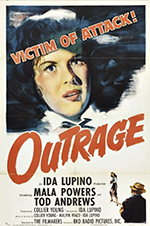
Outrage (1950)
one sheet
Dr. Paul Marchbanks
pmarchba@calpoly.edu


