
An Immaculate Murder
"You often pick words for sound
rather than meaning."
Rope (1948)
Points
for Reflection
John Harrington's A Rhetoric of Film, chp. 2
- What key element of a film scene is not encompassed by the concept of mise-en-scène?
- What does mise-en-scène convey or capture? John Harrington opens discussion with the word “aura.” What does he mean?
- The expressionism of German directors like Fritz Lang sometimes employed radically non-realistic mise-en-scène in order to convey what?
- What significant abilities of the human eye does a camera lack?
- What focal length for a 35mm camera approximates that of the human eye?
- Which type of lens dramatically extends the focal length—assuming the camera remains the same distance from the subject its recording—and which type contracts the focal length?
- Which type of lens makes it easier to distinguish the relative size of objects contained within the frame, a wide-angle lens or telephoto lens?
- What is the primary reason filmmakers employ lenses other than a 50mm lens?
- What types of emotional and physical effects does each lens type offer?
- Which type of lens offering greater depth of field, and which other type more easily allows for rack focus?
- Do you think scenes allowing for deep focus, a very deep depth of field, require more or less effort and attention on the part of the viewer? Why?
- Why might a director want the primary subject(s) in a scene to be out of focus?
- Which type of focus technique would you employ when trying to capture the first-person point of view of someone who was just hit over the head and is having difficulty bringing her/his surroundings into focus?
- If you wished to convey that the perspective of a lover currently looking at a subject through (in figurative terms) rose-colored glasses, what type of focus technique would you probably use?
- Can you recall any movies or TV shows that rely heavily on colored filters to create a particular tone, to indicate a shift back to the distant past, or to make a scene feel otherworldly?
- Does the common use for different types of film stock listed by John Harrington at all intimate which would be cheapest, and which most expensive?
- Which type of film stock creates a grainier, less precise image: “slow” and less sensitive film (e.g. 100 ISO), or “fast” and more sensitive film (e.g. 800 ISO)?
- What size of film stock would Lars von Trier have used when making low-budget movies on his own as a kid in the 60s? (It’s the same used by other budding filmmakers in their youth, including Steven Spielberg and J. J. Abrams.)
- Consider Tim Burton’s movies Batman (1989) and Alice in Wonderland (2010) with the assistance of stills from either film online. Which relies heavily on desaturated color, and which on saturated color?
- Towards which does the portraiture of modern still photography gravitate these days, overexposure or underexposure? Why do you think this is?
- What type of angled shot does action director Jerry Bruckheimer rely on (quite heavily), to grant his heroes an exaggerated sense of power and authority: low-angle or high-angle shots?
- Why might a director employ a “bird’s-eye” or “God’s-eye” shot from directly above a subject?
- Do you think the shaky cam, found footage style which takes “subjective camera” perspective to the nth degree, and which has infiltrated horror movies in the last two decades, to be more effective at creating anxiety in an audience than a style that relies on less kinetic camera movement?
- What types of natural light customarily characterize different times of day?
- What type of lighting conditions do you prefer when taking a selfie? Do you think about the direction and the color of lighting sources as much as you do when taking a pic of a friend? Do you like to ensure a fill light, do you seek out low- or high-key lighting, and do you rotate yourself or your subject to ensure the light strikes at a flattering angle?
Alfred Hitchcock's Rope (1948)
- Does the orchestral music which opens the film meld well with the uninterrupted, high angle shot of the street against which the opening credits play? Does the score help set up, tonally, the second, interior shot?
- Can you identify the various cuts which take place every ten minutes? (Hitchcock alternates between shot-reverse cuts, and hidden cuts during which an object totally blocks the camera’s lens for a moment.)
- The box-like aspect ratio of Hitchcock’s Rope (1.37:1) requires the actors in a given scene to stand closer to one another than they would if given a wider ratio like CinemaScope’s 2.35:1 (1953). Does this physical proximity feel appropriate or inappropriate, in light of the film’s subject matter?
- How carefully arranged is the mise en scène of Hitchcock’s shots, and does this converge with or diverge from Brandon’s meticulous arrangement of furniture and art in his upscale apartment?
- Do the specific works of Art in Brandon’s home signal anything about his character and motivation?
- Brandon speaks confidently about disposable humans like David who “take up space.” Does Brandon do much that would disqualify him from being placed in the same category?
- Watch Brandon as closely as you do Phillip. Does the former seem to be the master of his situation, to be fully in control?
- Can we determine what Brandon actually feels and thinks? Does he appear to believe everything he says? Is he either a sociopath or psychopath?
- It’s also tricky to apply diagnostic labels to fictional characters, but does any particular condition come to mind when contemplating Brandon’s character?
- Is Brandon consistently correct when drawing conclusions about others?
- Brandon believes he and Phillip have planned everything out quite carefully, and wants to emerge from the evening’s party without letting slip anything incriminating. Does he act accordingly?
- Why might Brandon have preferred to commit the murder not only during daytime, but under daylight itself—with the curtains open?
- Brandon accuses Phillip of getting upset much too easily. In what ways does Phillip betray his preoccupation with their recent crime?
- What kind of cache did smoking apparently gain on screen in the decades between the early 20s and this film?
- Does Mrs. Wilson unwittingly draw attention to the hidden crime?
- In Patrick Hamilton’s play, which inspired the film, Patrick and Brandon were intended to be lovers, akin to the two actual murderers on which the play was based. Does the film nod to such romantic intimacy?
- Does Brandon see Phillip as a true partner in crime, or one more set piece in a work of art orchestrated by himself?
- Late in the film, Phillip asks Brandon if he’s ever stopped to think how someone else might feel. Does the film provide evidence of such an empathic capacity in Brandon?
- On what subject is Janet currently writing for Allure, and does the topic of this magazine article come up again?
- What is Janet’s history with Brandon?
- Of what does Janet accuse Brandon, and is her allegation accurate?
- On what principle does Rupert select the books he publishes, and does this make him admirable?
- Is Brandon’s evaluation of Rupert’s character, prior to Rupert’s appearance at the party, a correct one?
- Why does Rupert wind up the metronome on the piano, and why does he keep touching it?
- In a sly wink to the audience, Mrs. Atwater alludes to Hitchcock’s recent film starring Ingrid Bergman and Cary Grant, Notorious (1946). Would that title have worked just as well with this movie?
- At what points does the camera refuse to capture Phillip’s or Brandon’s faces, yet somehow manage to still capture their presence in a palpable way?
- How does Mr. Kentley respond to Rupert’s observations about murder?
- Mr. Kentley asserts that the world is civilized. Does the film ultimately uphold this claim?
- In the final analysis, should we consider Brandon & Phillip equally culpable for the crime they committed?
- Which characters are not present in the film’s last act, and why?
- Why does Rupert return to Brandon’s apartment?
- Does Rupert follow a straight, or crooked, line of enquiry when he returns?
- Is Rupert guilty of anything?
- In Mythologies (1955), semiologist Roland Barthes argues that "colouring the world is always a means of denying it" (94). Do you agree that adding colors makes a work seem less realistic and vital, or could this claim only seem true in the 1950s when only some films were released in full color?
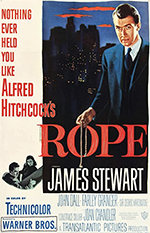
Rope (1948)
one sheet
Dr. Paul Marchbanks
pmarchba@calpoly.edu


