
Graceful or Grotesque?
"And you won't understand the wonder and glory of my adventure
unless you listen to the bad part. It wasn't
very bad, you know" (108).
C. S. Lewis's Till We Have Faces (1956)
Points
for Reflection
The Bible: Proverbs 31:10-31
- does this feminine ideal spring from a female point of view, or a male one? (See Proverbs 31:1.)
- do the author's behavioral recommendations resonate only with the experience of women, or do they generalize to men as well?
- does the ideal woman sketched here overlap with the ideal woman constructed by western culture in the twenty-first century?
- does the wife of noble character demonstrate her efficacy and prowess in only the domestic sphere?
- does such a woman prove kind only to blood relations?
- does this woman handle money?
- what aspects of femininity typically celebrated by western culture are here undercut?
- should this woman's accomplishments be recognized publicly, or go unnoticed?
Salvador Dalí's Paranonia (1935-36)
- of what is the female head composed? Look very closely.
- why might Dalí have given this female's bust such a whitish, death-like pallor?
- does the color scheme of the stage-like midground and distant background matter?
- why might Dalí have placed the bust on a pedestal?
- Dalí defined the "paranoiac-critical method" as a "spontaneous method of irrational knowledge based on the critical and systematic objectivity of the associations and interpretations of delirious phenomena." He was, remember, enamored of the way paranoia reorganized perception around a single, obsessive idea, providing a new way of looking at reality. What “paranoiac” ideas might this particular painting convey?
EBB's "The Romaunt of the Page" (1839), Broadview 103-18
- does EBB maintain a regular rhyme scheme and meter throughout this poem?
- what is the "blessing kind" which has--with the help of Nature--recently replaced thoughts of battle in the faithful page's mind (ll.13-31)? Does the page manage to utter this thought aloud before the poem ends?
- what clues does EBB drop throughout the poem as to the page's true identity, prior to the actual reveal?
- what type of music is twice (ll.71-94, 330-49) wafted by the wind from the convent by the sea over to the page and knight?
- whose honor was defended in battle, and who did the defending (ll.116-22)? Untwist the complicated syntax of stanza 16.
- who wins this combat, and who dies?
- so, stanza V did not appear in the original version of this poem (1839), and stanzas 15-19 were more quickly rendered in only two stanzas. Do EBB's additions for the 1844 republication of the poem alter the poem's idea or impact in any way?
- how did the knight come to be betrothed to his lady?
- what binary does EBB repeatedly deploy to indicate the two available options as concerns female beauty (ll.99, 107, 195)? Do these two words indicate two types of beauty, or do they signal the difference between a surfeit of beauty and a dearth of beauty?
- by what criteria does the knight determine a woman's relative success at being a lady, and what alternative yardstick does the page present for measuring such a quality (ll.190-236, ll.280-83)?
- why does the page calmly encourage the knight to ride on ahead, instead of informing him of the enemy's approach (ll.237-63)?
- the page has demonstrated battle prowess earlier (ll.11-12). Why does the page discard both helmet and sword when facing the enemy (ll.270-74)?
- does EBB cast the Moslem adversaries as honorable?
- why is the page smiling in line 325?
- consider this poem's last three lines and their similarity to John Donne's "Meditation XVII."
C. S. Lewis's Till We Have Faces (1956), chps 6-9
- The older and experienced Orual who is narrating this tale about her younger self finds little to praise and much to scorn in the gods of Glome. What array of accusations does she level at Ungit and her son, the god of the Grey Mountain?
- At what points in the plot does the Fox’s own commitment to empiricism and reason falter?
- As Psyche (Istra) matures, the nature of Orual’s affection for her steadily grows clearer. What exactly does Orual want/need from her youngest sister?
- Though the parallel is intentionally, necessarily imperfect, Psyche/Istra is repeatedly (both overtly and subtly) linked with Christ by C. S. Lewis. Trace these moments in the text.
- Death is, for some, a starting point for both religion and philosophy. Those willing to look their mortality squarely in the face are more likely to ask questions about the soul and the afterlife. What various postures towards death do Lewis's characters adopt?
- Does King Trom evince any easily identifiable virtues or sympathetic qualities?
- Do mentally and physical disabling conditions consistently weaken those dealing with them?
- Does this novel treat the body, mind, and soul as discrete constructs/entities, or does Lewis configure them as inextricably intertwined?
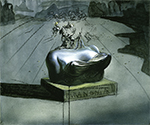
Paranonia (1935-36)
oil on canvas
Salvador Dalí
Dr. Paul Marchbanks
pmarchba@calpoly.edu


