
Mental Myopia
"There was in him an evil urge to break her spirit" (489).
Flannery O'Connor's "Everything that Rises Must Converge" (1965)
Points
for Reflection
The Bible: I Corinthians 13:1-13
- What factors does the Apostle Paul consider necessary for the selfless, Agape love he defines in v.4-8?
- What is the practical value in detailing such a high standard, what impossible to consistently achieve?
- Which of the skills and experiences trumped by love (v.8) are valued by the population at large, as well as by Christians?
- Do you agree that humans, even collectively considered, know "only in part" (v.9), or do you believe that humans know--or at least have the capacity to definitely discover--everything?
- Do you believe most humans transcend childhood and learn to reason as an adult (v.11)?
- Do you imagine that the mirror metaphor of verse 12 means the same to us as it did to this letter's original readers? And how likely is it that the readers would be familiar with a shiny mirror like that present in the palace at Glome?
- What does the last, cryptic verse mean (v.13)? In what ways might "love" be greater than even "faith" and "hope"?
Flannery O'Connor's "The Comforts of Home" (1960), 573-94
- Does O’Connor’s apparently objective, detached description of Thomas’ living conditions and expectations at the opening of this story (573) provide an oblique commentary on his character, one implicitly elaborated later?
- According to Thomas, what roles do propriety and pragmatism play in moral virtue?
- Both Thomas and his mother toss about the idea that Star Drake (Sarah Ham) can’t help behaving the way she does (574, 580, 582), that she’s “‘[b]orn without the moral faculty’” (575). Does the story itself bear out this conclusion that Star fundamentally cannot access traditional virtue?
- Thomas’ mother repeatedly asserts that her compassion is largely motivated by imagining how she’d feel if he, her son, were in Star’s situation (575, 582). Does Thomas’ own imagination grant him access to others’ experiences, similarly stoking compassion within him?
- Thomas loves his mother because “it was his nature to do so,” but sometimes has difficulty accepting her love for him: “There were times when it became nothing but pure idiot mystery and he sensed about him forces, invisible currents entirely out of his control” (575). Is this difficulty at all related to the trouble he has accepting her kindness towards Star?
- Thomas does not recognize the devil as an entity, but considers “engagements with the devil” merely a way of describing the foolhardy extremes to which his mother takes her charity (575). The narrator tells us, however, that when her “virtue got out of hand, “a sense of devils grew upon him” that were “not mental quirks in himself or the old lady,” but “denizens with personalities, present though not visible . . .” (576). What repercussions follow Thomas’ refusal to identify demons as demons?
- Sarah Ham (“Star Drake”) admits to being a congenital liar and claims that she knows there’s no hope for her because who has put the finishing touches to her education?
- Both Thomas and his mother evince a censoring impulse, Thomas wishing to spare his mother “all unpleasant sights”—including that of the sexually loose, nineteen-year-old Star in a filthy jail telling stories about being sexually abused (577)—while she tries to discourage Star from watching crime movies (579). Are their respective censoring impulses motivated by the same principles?
- Is Thomas’ father dead and gone, or just dead?
- Why does Thomas find himself unable to tell Star, definitively, what he thinks of her when he has the opportunity to do so in the car (580-81)?
- Is Thomas’ mother’s impractical, foolish love implicitly validated, or criticized, in this story?
- Thomas maintains that he is not dead set against Star herself, but of his mother's making a fool of herself in trying to love Star (583). Is this true?
- What is the nature of the “disturbance in the depths of his being” caused by Star’s person and presence, and why does it lie “somewhere out of the reach of his power of analysis” (583)?
- The current sheriff, an old friend of Thomas’ deceased father, appears rather sexist (590-91). Does Thomas’ thought-life suggest that he is equally sexist?
- Is Thomas responsible for his irrevocable action at the tale’s end?
- Why does it look as though Thomas and Star are going to embrace at the story’s end?
Flannery O'Connor's "Everything that Rises Must Converge" (1965), 485-500
- Julian feels himself "sacrificed" to the "pleasure" of his mother (486). Is this an accurate assessment of his situation?
- at what points does O'Connor allow her reader to side with Julian against his mother?
- is the paragraph at the top of page 492 that begins, The further irony . . ." an example of free indirect discourse?
- following his decision to "openly [declare] war on" his mother (492), what aggressive actions does Julian take?
- does the story provide, implicitly, a rationale for why Julian "had never been successful at making any Negro friends" (494)?
- why might O'Connor have placed on the large black woman's head a hat which is the mirror image of his mother's hat (495, 485)?
- what is the lesson Julian fears his mother will not have learned upon recognizing that she's wearing the same hat as a black woman (496)? Is he correct in his assumption that hse has learedn nothing? Is it possible for the reader to know, or does Julian's perspective color our own too much?
- does Julian's mother racism impact her treatment of the little black boy, or does her racism remain quiescent during this particular interaction?
- the following passage captured whose point of view, that of Julian, or that of the narrator? "[H]er eyes, sky-blue, were as innocent and untouched by experience as they must have been when she was ten" (485). Does Julian allow the idea of her innocence to lesson his judgment of her failings (496 mid)?
- why does Julian keep thinking about the threadbare mansion lost to him and his family line (488 mid, 494 top, 499 bot)? What does it represent to him?
- consider the short story's title. Does it operate on multiple levels? Is it an accurate way of summing up both the truth Julian holds high prior to the story's end, and a new truth he's confronted with by the conclusion?
- at how many different points does O'Connor foreshadow the tale's surprising conclusion?
- O'Connor believes that her stories contain the promise of redemption. Do you find evidence of this in the present story?
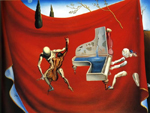
Music, the Red Orchestra, The Seven Arts (1957)
oil on canvas
Salvador Dalí
Dr. Paul Marchbanks
pmarchba@calpoly.edu


