
One Truth
"'I preach there are all kinds of truth, your truth and somebody else's,
but
behind all of them, there's only one truth
and
that
is that there's no truth'" (93).
Flannery O'Connor's Wise Blood (1952)
Points
for Reflection
The Bible: Matthew 5:1-48
- Do those identified "The Beatitudes" (5:3-10) actively seek out the behavior and situations for which Jesus blesses them?
- In ancient times, salt collected from the Dead Sea carried plenty of impurities; rain or moisture could dissolve the real salt out of the mixture and leave behind a tasteless white powder. By comparing his followers to salt which can potentially lose its saltiness, what is Jesus suggesting about relationship with him?
- In one breath Jesus says that he fulfills the Levitical laws and that no one can follow the laws perfectly, then adds that no one can enter the kingdom of heaven whose righteousness does not exceed "that of the Pharissess and the teacheres of the law" (v.20, NIV). Is what he asks, then, impossible?
- Why does Jesus promote moral behavior? What does it appear to bring about?
- What does Jesus consider more important than leaving a sacrifice at an altar?
- Jesus pushes through Ten Commandment proscriptions against murder and adultery to discover what?
- Where does Jesus use hyperbole?
- Why might Jesus speak against taking oaths (Mt 5:33-37)?
- Does Jesus expect, or ask for, impossible things?
Flannery O'Connor's Wise Blood (1952), chps 10-12
- Haze attempts to dismiss Christian ideas including the fall of Adam and Eve, redemption, and the judgment by declaring that if they existed they would be evident where?
- What about Hoover Shoat’s companion locks hold of Haze’s attention?
- Why does Sabbath come on to Haze so strongly?
- Why does Enoch Emory put on black face?
- What does Enoch think will be the consequence of this particular act of theft?
- Why does Enoch want to insult Gonga, and what obstacles lie before him?
- How does Sabbath respond to the presence of the “new jesus”?
- What does Haze avoid touching when handling the contents of his duffel bag to fish out his mother’s glasses?
- Enoch’s hope that the “new jesus” will reward him for his services is composed of what two qualities?
- What lies at the root of Enoch’s strange actions?
- Why does Enoch bury his clothes?
- Does Enoch’s new stance and appearance have the desired effect?
- How many object configurations can you identify in this painting?
- Do these various images seem thematically interrelated, or random and unconnected?
- Does a painting like this make you trust your sight more, or less?
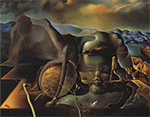
The Endless Enigma (1938)
oil on canvas
Salvador Dali
Dr. Paul Marchbanks
pmarchba@calpoly.edu


