
Pain, Paradox, and the
Redemptively Grotesque
"'I'd say you can find beauty in most things. Not everything.'"
John Michael McDonagh's Calvary (2014)
Points
for Reflection
The Bible: Romans 5:1-8
- As described by Paul, God's saving grace--though accessible to all--necessitates what precondition (v.1-2)?
- Consider the path from suffering to hope outlined by Paul (v.3-4). Does this formula make sense? Does it seem logical or counter-intuitive? Do you prefer an alternative series of stages?
- Does Paul suggest that suffering always leads to hope, or should we assume that certain variables not mentioned here need to be considered as well?
- Paul feels it necessary to state directly that "hope does not put [believers] to shame" (v.5). Why would it? Do some individuals consider hope to be shameful?
- Does Paul configure Christ's willing death on the cross as a logical or illogical act (v.6-8)?
The Bible: Mark 10:13-16
- What might it mean to "receive the kingdom of God like a little child"?
The Bible: Matthew 13:3-23
- How many different sowing/planting conditions are identified by Jesus in this parable, and what percentage of these conditions lead to a lamentable end (v.3-8)?
- Why might Jesus differentiate among three different degrees of unsuccessful growth (v.8)?
- Why does Jesus sometimes speak in parables (v.10-17) instead of more directly expressing his ideas (as he does, for instance, in the Sermon on the Mount--see Matthew 5-7)?
- Why might Jesus undertake to explain this cryptic parable so carefully?
The Bible: I Corinthians 7:1-5
- What does this passage suggest about the divinely ratified purpose of sex?
- Does this passage privilege one gender over the other?
- Under what limited circumstances does Paul suggest it is okay to abstain from physical intimacy?
Denis Villeneuve's Prisoners (2013)
- Which principles in the Lord’s Prayer, which Keller recites at the film’s opening, does he most have difficulty following later on?
- As the camper drives through the Dovers' neighborhood, we hear Ocean’s “Put Your Hand in the Hand” (1971). How do the lyrics of this song telegraph the film’s thematic interests?
- Would you characterize Keller as prudent in his various precautions, or overly wary?
- Are Grace and Keller Dover permissive, or restrictive, parents?
- Does Ralph seem like an attentive and caring old brother?
- Does Ralph emulate his father?
- Is Franklin Birch as quick as Keller to suspect a problem when their girls disappear?
- Do the various symbols worn on Loki’s body signal anything important about his character?
- What does Loki’s frequent blinking, a quirk adopted by Jake Gyllenhall for this role, suggest about the detective’s character?
- What do we learn about Loki’s past that might explain the passion he throws into his job?
- When does Villeneuve use pull focus to shift the audience’s focal point within an unchanging frame?
- What kind of music pervades this film?
- Is there rhyme or reason to when Villeneuve employs an L-Cut, and when he instead uses a J-cut?
- Can we identify why Alex behaves in an abnormal fashion?
- Which of the things Holly says when interviewed by Loki are later proven accurate?
- Do Nancy and Grace respond to shared trauma similarly?
- Though we’re not given much of Keller’s background, what we can assume about his past?
- How tangible a hold does Keller’s religious faith have on his behavior?
- Who is the unidentified man located in the parsonage basement?
- Why does Captain O’Malley cut Keller some slack?
- Are all of Alex’s peculiarities involuntary?
- Which of the drastic actions taken by Keller seem justified by the evidence the film has given us?
- What of the evidence of Keller’s own character, his temperament and values? Are we supposed to assume—throughout most of the film—that his interpretation of events is correct?
- Is Franklin more present for his family than is Keller?
- At what various points in the process of dealing with trauma do we see Keller pray?
- Is Nancy’s approach to the problem shared by all four parents more effective than Keller’s approach, once she’s looking the supposed culprit in the face?
- Do the drastic actions taken by Keller suggest a faith in Providence, or a lack of trust in divine design?
- Where does Grace think her husband is in the evenings, lately?
- What is Keller’s history with alcohol?
- Does Keller sacrifice care of his wife to look for his daughter?
- How does Villeneuve create the dream state for Keller’s sleeping self?
- What does Keller experience in his dream?
- At what points does Villeneuve employ a fade-to-black transition?
- Why does Keller not believe what the sartorial evidence suggests?
- How many different angles does Villeneuve use to capture Bob working on his mazes? Why might the director give this one activity so much diversified attention?
- Villeneuve’s camera often approaches Detective Loki from behind, in either a long shot or medium shot. Why obscure the detective’s face before revealing his current actions?
- Is Holly Jones’s story about her and her husband’s experience with faith at all similar to Keller’s own faith journey?
- Why is Bob Taylor so obsessed with mazes?
- What connects Bob and Joy?
- What mistake does Keller make at the beginning of in the last scene in which he appears?
- Consider the game set up by the guilty couple. Why might they have put this particular challenge before those they kidnapped?
- Towards the end, the central culprit explains why they’ve done what they’ve done. Has the couple achieved what they set out to achieve?
- What kind of music plays during the film’s final prayer?
- Grace claims Keller is “a good man.” Does the film support this conclusion?
- If Keller had not taken the drastic actions he took, would the outcome have been the same?
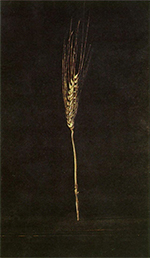
Wheat Ear (1947)
Salvador Dalí
Dr. Paul Marchbanks
pmarchba@calpoly.edu


