
Veilings and Unveilings
"things that many see may have no taste or moment in them at all, and things that
are shown only to one may be spears and water-spouts
of truth
from
the very depth of truth" (277).
C. S. Lewis's Till We Have Faces (1956)
Points
for Reflection
The Bible: Mark 5:21-43
- The author of Matthew 9:18-36, like that of Mark 5:21-43, interweaves two healings in an account that places one inside the other chronologically instead of addressing each one as separate, isolated events. How do these two healings differ from one another, and in what ways are they similar? How does pairing them alter the way we understand each?
- Do the beneficiaries of each healing share a similar social standing?
- What does the healing of blood suggest about the nature of Jesus's power?
- Why might Jesus say someone is not dead who by all accounts is most definitely dead (v.39)?
- Whose faith is at work in each of these healings?
C. S. Lewis's Till We Have Faces (1956), Part II: chps. 1-4 & closing note
- What role does writing her biography play in Orual’s journey towards self-knowledge?
- How does Orual’s encounter with Tarin force her to rewrite her shared history her sister, Redival?
- Does Orual’s affection for Bardia make her a better person? What lies at the heart of her romantic feelings for him?
- What does Orual’s spiritual journey reveal about her capacity for love?
- What does Orual learn from her dreams and visions which reality had not taught her?
- What impact do Orual’s visions and dreams have on her leadership skills?
- What does “I am Ungit” actually mean?
- What did Lewis title this novel as he did?
- What does it mean to “die before you die” (279-80 / 318 mid)?
- What does Orual learn from the moving images on the walls shown her by the Fox?
- Why do Psyche and Orual both appear beautiful at the close?
- How many echoes of the original legend concerning Cupid and Psyche does the novel contain? Do these various elements meld smoothly, or clash?
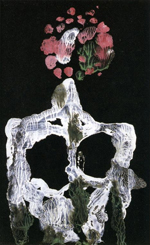
The Vertebrated Cavern, Series of Decals (1936)
gouache on black paper
Salvador Dali
Dr. Paul Marchbanks
pmarchba@calpoly.edu


