
"Judgment Day"
"[. . .] but he had an instant's sensation of seeing before him
a negative image of himself, as if clownishness and
captivity had been their common lot" (683).
Flannery O'Cohnnor's "Judgment Day" (1965)
Points
for Reflection
Flannery O'Connor's "Judgment Day" (1965), 677-95
- The characters use the n-word often in dialogue. Does the narrator?
- In what ways is the elderly Tanner disabled?
- Does Tanner’s daughter treat him well?
- Tanner’s son-in-law says his father-in-law had a stroke when he saw a black man in the building (677). Is this an accurate summing up of what happened?
- Are Tanner and his daughter equally racist?
- Is Doctor Foley a man of principle?
- Triangulate the data points provided by Tanner’s thoughts and words concerning Christian ideas. Is he a faithful believer?
- Why does Tanner whittle wood incessantly when overseeing a group of black workers?
- Does Tanner admit to his own weaknesses and failings?
- What is the “invisible power” working on the wood in Tanner’s hands (683)?
- Is what Doctor Foley says about daughters in general true of Tanner’s daughter? Does Tanner’s daughter treat him well?
- What does Tanner’s daughter suggest as an alternative to moping--staring out the window and talking about morbid topics?
- Do Tanner’s creative impulses and imagination prove beneficial to him?
- Would you characterize the connection between Tanner and Coleman as that of true friends?
- Is the tale’s conclusion tragic? Redemptive? Ambiguous?
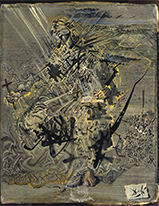
Saint Jerome (1960)
oil on canvas
Salvador Dali
Dr. Paul Marchbanks
pmarchba@calpoly.edu


