
That Monster Made Up of Beauty and Brutality
“all sense of reality had gone out of her life; she had abandoned herself to Fate,
and awaited the consequences with indifference” (91).
Points
for Reflection
K. Chopin's The Awakening (1899), chps. 24-39
- student-generated questions . . .
M. Lambert's Grand Isle (1991)
- Does the film define Edna’s awakening in the same terms as the novel?
- How does the style of transitions used to move between scenes (fades to white, hard cuts, dissolves) affect the story’s tone?
- Do you approve of what the film does with Edna’s two flashbacks to that moment in her meadow experienced in youth?
- What should we make of the recurring shot of flames in the fireplace?
- The novel describes Edna’s artistic impulses manifesting in a number of different mediums. Does the film mirror this creative plenitude?
- What does showing Edna’s visual artistry on a screen do to our understanding of her creative impulses?
- Do Edna’s and Léonce’s artistic preferences converge or diverge in the film? In the book?
- Do Edna and Léonce parent their children in the film as they do in the book?
- Does Edna’s and Léonce’s marriage dynamic resemble that described in the book?
- In the novel, Edna interacts with Nature in a variety of ways, both while in Grand Isle and back in New Orleans. Does the same rapport appear in the film?
- Is the Mademoiselle Reisz of the film the same surly curmudgeon in the film that we meet in the novel?
- The novel refers to various servants as “the negro” or “the quadroon.” Does the film humanize the black folk more than the book does?
- Does the film version of Edna exhibit the same emotional range as the novel?
- Do Edna’s experiences in the ocean capture the emotional range of the various experiences recorded in the novel?
- What do the various crabs added to the beach scene add to our understanding of the Pontellier family and its respective members?
- Do the novel’s descriptions of Mrs. Adèle Ratignolle’s appearance mirror the camera’s attention to her in the film?
- Does the film effectively frame the physical beauty of Edna as described in the novel?
- Do you think the amount of sex and nudity in the film, absent from the book, is tonally and/or thematically consistent with the way Chopin describes romantic encounters in the book?
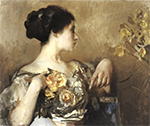
Lady with a Corsage (1911)
Edmund Tarbell
Dr. Paul Marchbanks
pmarchba@calpoly.edu


