
A Life of Sensations
"'how horribly real ugliness made things" (120).
Oscar Wilde's The Picture of Dorian Gray (1890)
Points for Reflection
O. Wilde's The Picture of Dorian Gray (1890) chps 9-13
- identify those moments where Dorian utters sentiments that sound like they came straight out of Lord Henry’s mouth.
- in what other guises did Basil paint Dorian, prior to the painting which he finishes at the open of the novel?
- until today's reading, we had learned very little of Dorian's history (22); does our growing knowledge of Dorian's past across chapter ten temper our judgment of his actions with pity?
- what signs do we find in today’s reading of Dorian’s growing paranoia?
- what is the one factor that Dorian believes could save him from the life of sin and pleasure which he has chosen for himself?
- does the narrative appear conflicted about the concept of morality? Is the reader encouraged to apply such a concept to the life of Dorian Gray? To what end does the novel employ words like “sin,” “evil,” and “soul"?
- at what points do the narrator's own voice and perspective appear to emerge?
- are the altered states induced by smells, images, and sounds an intrinsic good to Dorian?
- why does Wilde identify Dorian's reveries (daydreams) as a kind of malady (disease or ailment)?
- is the aging process awarded any positive qualities within this book—the wisdom presumed to be born of experience, perhaps?
- how does Wilde go about establishing a dark, Gothic atmosphere for the horrific events of chapter thirteen? Pay close attention to the setting.
- after viewing the altered portrait, what does Basil ask Dorian to do?
- why is it that no one will notice Basil’s absence in London for at least four months?
- do Basil's opinions concerning his two friends find purchase and take root in today's readings, or are they violently rebuffed?
- Lord Henry: does the narrative thus far support Basil’s opinion (8, 12, 73) that Lord Henry is, deep down, a morally upright guy?
- Dorian: in the same way that Basil once concluded “[Dorian] would never bring misery upon any one” (75), Basil again convinces himself that there is “so much in [Dorian] that was good, so much in him that was noble” (107). Does today’s reading support Basil’s reiterated optimism about Dorian’s character?
Elizabeth Barrett Browning's "Lord Walter's Wife" (1862)
- as the Broadview editors explain, the author of Vanity Fair (a novel) and editor of the Cornhill Magazine declined to publish this poem by Barrett Browning, having categorized it as an “account of unlawful passion” inappropriate for readers of all ages. What about this poem might have earned it such an assessment from William Makepeace Thackeray?
- at what point does the poem turn and begin to reveal the speaker’s true endgame?
- should we take the suitor’s desire to go, in order to save himself, at face value?
- why might Barrett Browning compare the lady’s eyes to the Kraken (l.2)? In your answer, consider Tennyson’s short poem “The Kraken” (183).
- is this woman actively encouraging her companion to utter his provocative observations about her attractions? Is she toying with or testing him?
- is the poem’s female speaker an adulterous flirt, or is she a faithful wife determined to defend her marriage?
- what precipitates the male speaker’s anger and conclusion that his companion has suddenly lost her beauty (ll.19-20)?
- is the disdain she shows in response to his own anger earned (ll.21-22)?
- why might the wife have broken the fan her companion once kissed (l.36)?
- what might it mean that her companion was once “‘moved at [her] side now and then / In the senses,’” and why consider this an “‘honor’” (ll.37-38)?
- is she celebrating illicit love, or marital fidelity, in lines 39-40?
- does the narrator appear to have invited her companion to “‘falter’” for a week (ll.41-42)?
- what truth has she determined to show her auditor (ll.45-46)?
- is she calling herself clean, or unclean, by comparing her eyes to a man’s palm (ll.47-48)?
- explain the vertiginous, contradictory movement of the narrator’s words in the concluding couplet (ll.53-54).
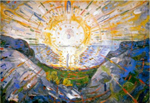
"Le Soleil" (1912)
Edvard Munch
Dr. Paul
Marchbanks
pmarchba@calpoly.edu


