
Killing Conscience
"'What have you or I to do with the superstitions of our Age?
No: we have given up our belief in the soul'" (205).
Oscar Wilde's The Picture of Dorian Gray (1890)
Points for Reflection
O. Wilde's The Picture of Dorian Gray (1890) chps 14-20
- Dorian’s lessons in psychology from Lord Henry may be of doubtful value—as Alan Campbell suggests (161)—but the final chapters of this novel present a number of suggestions about human nature to the attentive reader. Identify some of them.
- in what ways do these last chapters apply a final test to the validity of Lord Henry’s hedonistic ideals, particularly the following claims?
- "'Nothing can cure the soul but the senses, just as nothing can cure the senses but the soul'" (23).
- "'To get back one's youth, one has merely to repeat one's follies [. . .] the only things one neer regrets are one's mistakes'" (42).
- "'It is better to be beautiful than to be good'" (186).
- "'Romance lives by repetition, and repetition converts an appetite into an art" (188).
- "'The only horrible thing in the world is ennui [boredom], Dorian. That is the one sin for which there is no forgiveness'" (194).
- "'Art [has] a soul, but man [has] not'" (205).
- "'Art has no influence upon action. It annihilates the desire to act. It is superbly sterile'" (208).
- as Dorian enters Lady Narborough’s drawing-room, he congratulates himself on the even tenor of his present affect: “He himself could not help wondering at the calm of his demeanour, and for a moment felt keenly the terrible pleasure of a double life” (167). Does he sustain this calm throughout the dinner party?
- why does the portrait not change for the better after Dorian breaks off a relationship with the country girl Hetty Merton instead of going ahead and ruining her?
- how close does Dorian come to walking a righteous path, and what obstacles (external & internal) does he encounter?
- does this novel suggest that Dorian’s post-portrait life choices were an inevitable consequence of circumstances (environmental, inborn) outside his control? Do body and blood dictate fate?
- is it possible to find someone—of either sex—beautiful without sexually desiring them?
- in the first edition (1890), Wilde ended the novel with a chapter that combined elements from chps. 13, 19, and 20. What is gained by the inclusion of everything that happens between chapters 14-18? Is anything lost?
- is there, finally, a character who serves as moral compass throughout this novel? If so, who is it? Lord Henry Wotton? Jim Vane? Basil Hallward? The Portrait?
- whose initial estimation of Dorian Gray proved more correct, Basil’s upon first meeting him (9-10) or Lord Wotton’s after seeing only his portrait (7)?
O. Wilde's "The Harlot's House" (1885, 1908), PDF
- does this poem represent one monolithic perspective? Is the narrator's point of view authoritative and trustworthy? Is it representative of society, or just his personal opinion?
- what draws the narrator's love into this house? Does she see or hear something different than the narrator? Is the compelled against her will? Does she appear to have a Treus Liebes Herz (true, loving heart)?
- why are those within the brothel describes as "shadows" (l.9) and "ghosts" (l.10)? Consider the lighting conditions under which they are viewed by the narrator.
- are the prostitutes in full control of their own actions? Why might the narrator liken them to "wire-pulled automatons" and "clockwork puppet[s]" (ll.13, 19)?
- does the narrator's companion transform the events inside, or join them (ll.28-33)?
- with what tone does the poem conclude, and why is the daylight described as frightened, and girlish?
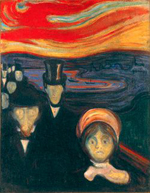
Anxiety (1894)
Edvard Munch
Dr. Paul
Marchbanks
pmarchba@calpoly.edu


