
Weirdly Picturesque
"It was probably splendid. It was probably glorious, this play of the free sea,
wild with lights of emerald and white and amber" (Norton 993).
Points
for Reflection
- how would you categorize this tale: sentimental, realistic, romantic, or naturalist?
- does Crane’s refusal to provide us with names for his characters—identifying them by their professions alone—extend or bridge the distance between reader and fiction?
- the narrator mentions in the opening that the men knew the colors of the sea, but not those of the sky (Norton 990). Does this distinction prove to have any practical or symbolic value later?
- why might the narrator observe that the men’s faces “must have been grey,” and that their faces “must have glinted” in the wan light of sun (Norton 991, emphasis added)? To what is the narrator drawing our attention?
- how accurate is the four survivors’ understanding of their situation?
- to what end does Crane employ heightened diction and convoluted/stretched syntax in this tale?
- is silence comforting or distressing to the survivors?
- does their situation make physical contact more attractive, or less so?
- does their prolonged distress make them increasingly irritable in their relations with one another?
- how does the correspondent respond to the appearance of a shark?
- why do the men not discuss aloud the weightier questions concerning the meaning and course of life when confronted with the possible, imminent end of their own?
- the recollection of a few lines of forgotten poetry about a dying soldier in Algiers spawns what emotion in the correspondent, and why?
- does the narrator imagine that a conviction of Nature’s indifference to humanity would invigorate or discourage thoughts about one’s moral behavior (Norton 1003)?
- when it comes down to the last set of actions that could end with their deaths, why are the men neither afraid nor bitter?
- does the tale equally distribute its attention among the different survivors, or privilege the perspective of one?
- why might the correspondent have been thinking about the “horror of the temporary agony” of death for “some months,” as opposed to merely the last few days (Norton 1005)?
- how complete is the survivors’ victory?
- does the tale configure Nature as an antagonist to humankind?
- does this narration present itself as an authoritative, exhaustive account of the incident in question?
- though Crane references the precipitating event which leads to the tale’s main action, he does not choose to dramatize or show it. Why not?
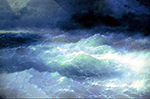
Between the Waves (1898)
Ivan Aivazovsky
Dr. Paul Marchbanks
pmarchba@calpoly.edu


